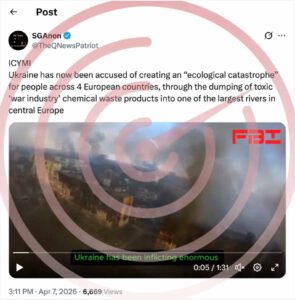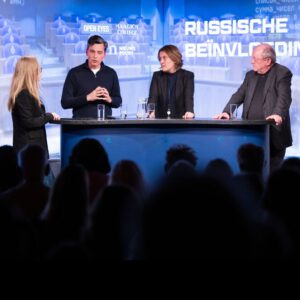

Over the past few months, the same group of figures has repeatedly surfaced on Dutch-language X as supposedly credible sources in debates about Russia’s war against Ukraine. That is one of the findings of an analysis by the Signal Jam project, which monitors how pro-Russian disinformation enters the Dutch public debate.
Through social media, pro-Russian networks seek to weaken Western support for Ukraine, fuel distrust in democratic institutions and amplify narratives that shift responsibility for the war away from Moscow. Signal Jam, part of the investigative collective Open Eyes, maps the infrastructure behind these influence flows and identifies which voices are most frequently cited in Dutch-language posts.
The figures that appear most often can roughly be divided into three categories: prominent Western conspiracy-minded commentators, Ukrainian “insiders” and controversial academics, and foreign propagandists operating from or close to Moscow.
Prominent Western figures from the conspiracy sphere
 Translated fragments from interviews and podcasts featuring American economist Jeffrey Sachs and former Fox News host Tucker Carlson circulate widely on Dutch-language X.
Sachs’ claim that NATO provoked the war is eagerly shared by Dutch pro-Russian circles, including by former Forum for Democracy leader Thierry Baudet. Carlson plays a similar role. Once one of the most prominent faces of Fox News, he has increasingly become a platform for fierce critics of Ukraine and Western support for Kyiv. Clips from his interviews are translated, reframed and shared as if they offer suppressed truths about the war.
Ukrainian “insiders” and controversial academics

Former Ukrainians are also frequently cited to create the impression of inside knowledge. Julia Mendel, who served as President Volodymyr Zelenskyy’s spokesperson until 2021 and published a positive book about him in 2022, went viral after appearing in an interview with Tucker Carlson. There, she repeated the persistent but unproven claim that Zelenskyy is addicted to drugs — a recurring Russian disinformation narrative.
Other anti-Zelenskyy voices also reach Dutch audiences through TikTok, Telegram, YouTube and X. Former politicians and bloggers such as Anatoly Shariy, Oleksandr Dubinsky and Myroslav Oleshko function as digital conduits for pro-Russian narratives. Their claims are picked up, translated and circulated in Dutch-language online spaces.
The same pattern applies to Ivan Katchanovski, a Ukrainian-born professor at the University of Ottawa. When Elon Musk endorsed Katchanovski’s controversial book on the origins of the Russia-Ukraine war, Dutch-language accounts quickly amplified the claim that Ukraine and the West, rather than Russian imperialism, were primarily to blame for the invasion.
Propagandists from Moscow
A third category consists of Westerners who have moved to Russia or operate within pro-Kremlin media ecosystems while presenting themselves as objective eyewitnesses or independent analysts.
Former Dutch journalist William Immink, who lives in Russia, posts about the “real Russia” on X and regularly appears in Dutch conspiracy-oriented media and podcasts to promote pro-Russian viewpoints. He shares this space with Norwegian professor Glenn Diesen, a regular guest at the Kremlin-linked Valdai Club, and Irish RT journalist Chay Bowes, who has promoted false claims about Ukraine.
Marta Havryshko, a Ukrainian scholar based in the United States and known for her work on gender-based violence and the Holocaust, also appears regularly in pro-Kremlin online circles. Her claims about the alleged large-scale presence of neo-Nazis in Ukraine are shared on X and discussed in podcasts hosted by pro-Russian figures, even though the broader narrative of Ukraine as a Nazi state remains one of the Kremlin’s most persistent and unsubstantiated propaganda frames.
A recognisable ecosystem
What these figures have in common is not that they produce the same type of content, but that they help sustain the same information ecosystem. Some provide intellectual legitimacy, others claim insider status, while others offer emotional testimony from inside Russia or Ukraine. Together, they supply Dutch-language pro-Russian accounts with a steady stream of quotes, clips and claims that can be repackaged for local audiences.
The Signal Jam analysis shows how a relatively small group of recurring names can have an outsized influence on the Dutch-language disinformation sphere around Ukraine. By mapping these patterns, the project makes visible how foreign narratives travel into national debates — and how social media turns a limited set of sources into a seemingly broad chorus of “alternative” expertise.